

History
History
- 1945
- Founded as Toshiba Corp. Asahikawa Works (Manufacturing household lamp)
- 1950
- Broke away from Toshiba. Hokuto Electric Lamp Mfg. Co., ltd. incorporated
- 1967
- Company name changed to Hokuto Electronics Industries Co., ltd.
- 1993
- Company name changed to Toshiba Hokuto Electronics Corporation
- 2003
- Toshiba Hokuto Electronic Devices (Thailand) Co., ltd established
- 2007
- Company mark changed to Toshiba logo
- 2022
- Merged with Hokuto Service Co., Ltd. through an absorption-type merger
Technical Milestones
- 1960
- Manufacturing of Monochrome TV tubes started
- 1975
- Manufacturing of Industrial-use tubes started
- 1978
- Manufacturing of Monochrome Display tubes started
- 1986
- Manufacturing of Electron Gun for color picture tubes started
- 1990
- Manufacturing of flexible printed circuit started
Manufacturing of magnetrons for microwave oven started - 1992
- Manufacturing of surface acoustic devices started
- 1997
- Manufacturing of thermal print head started
- 1999
- Transferred projection tubes business started
Manufacturing of oxide single crystals started - 2000
- Transferred manufacturing of magnetrons to Toshiba Display Devices (Thailand) co.,ltd.
- 2002
- Manufacturing of surface acoustic devices closed
Transferred thermal print head business started - 2003
- Avionics color display tubes business started
- 2007
- DNA chips business started
- 2008
- Manufacturing of DNA chips for non-medical use commenced
- 2009
- Manufacturing of DNA chips for medical use commenced
- 2015
- Business related to industrial magnetrons
- 2017
- Manufacturing of Active Metal Brazed Copper Circuit Boards
Special Feature: Hokuto Electronics' History: Looking Back at 50 Years of History
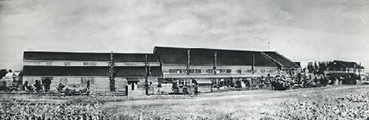
Founding of Toshiba Asahikawa Factory, the predecessor of Hokuto
Carrying the great expectations of the local community, the company began as the only light bulb factory in Hokkaido
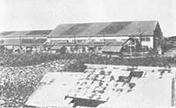
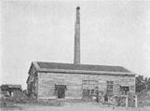
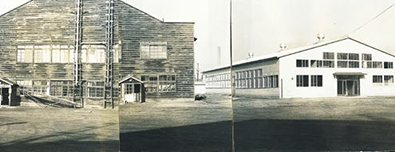
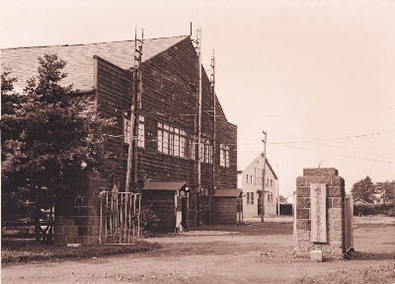
A panoramic view of the founding factory
Founding day marked the beginning of peace
The attraction of the Asahikawa Factory of Tokyo Shibaura Electric Co., Ltd., the predecessor of our company, began during World War II when the company planned to evacuate the factory, which was at high risk of air raids, and approached the Hokkaido government for suitable locations. In response, the Hokkaido government recommended Sapporo, Otaru, Muroran, and Hakodate, and Toshiba headquarters began conducting field surveys in the spring of 1943.
When Eiichi Yamamoto, who was an Asahikawa City Council member and director of the Asahikawa Chamber of Commerce and Industry at the time, heard about Toshiba's factory evacuation, he immediately began working to attract the company to Asahikawa.
Asahikawa, located in the center of the Kamikawa Basin, which is filled with fertile farming areas, was looking to transition from a rural urban area to a modern city centered on secondary industry, with manufacturing at its core.
However, attracting a factory was considered difficult due to the region's cold, snowy climate and the transportation difficulties of being inland with no port.
But despite this, Councilman Yamamoto, Asahikawa city authorities, and the Chamber of Commerce and Industry came together to campaign for the location, highlighting the availability of repurposed buildings, the factory site being close to a gas company, the ease of securing labor, and the favorable food situation.
This enthusiasm was well received by Toshiba's management, and in September 1943, it was decided to build an evacuation factory in Asahikawa.
The Potsdam Declaration was accepted on August 14, 1945. The company's founding ceremony was held at noon the following day, the 15th, one hour after the Emperor's Rescript on the Termination of the War was broadcast over the radio.
This truly marked the beginning of Japan's greatest post-war peaceful industry.
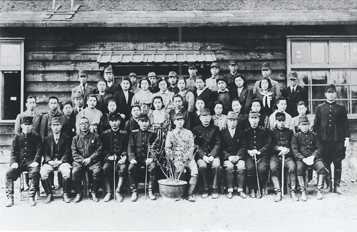
Plan to sell Asahikawa Factory under the Law Concentration Elimination of Concentration
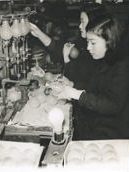
Toshiba Asahikawa Factory, the only light bulb factory in Hokkaido, began production with a target of producing 400,000 units per month.
Due to various problems resulting from the post-war chaos, such as shortages of materials, difficulty in obtaining raw materials, irregular gas supplies, and shortages of manufacturing machinery and parts, production fell significantly. However, the company sought to improve its technology by inviting technical instructors from Toshiba's Horikawamachi Plant, and by expanding its workforce, it gradually increased production.
Meanwhile, GHQ (Supreme Commander for the Allied Powers Occupation of Japan), which ruled Japan, planned major reforms, including the dissolution of 15 zaibatsu, as part of a policy to democratize the economic system (dissolution of the zaibatsu and land reform).
In mid-1947, the Law on the Elimination of Excessive Concentration of Economic Power was enacted.
Toshiba was also designated under the Waste Collection and Waste Management Act in February 1948, and in February 1949, the Asahikawa Plant was designated as a plant for disposal after receiving a notice of a draft directive for a reorganization plan.
The issue of whether to close the Asahikawa factory caused a major stir in the Asahikawa economy, and Eiichi Yamamoto, who had strongly supported the move, as well as Asahikawa city authorities and the Chamber of Commerce and Industry, made desperate appeals.
Meanwhile, in preparation for the sale, in January 1950, the company began "producing the new Hokuto brand lamps and implementing an independent accounting system."
Toshiba headquarters decided to sell the Asahikawa factory and asked Eiichi Yamamoto to purchase the factory on the condition that "Toshiba would provide the materials and parts, Toshiba would purchase 70% of the products under the Mazda lamp mark, and the remaining 30% would be freely sold under the Hokuto mark."
The founding promoters of Hokuto Electric Light Bulb Industry Co., Ltd. met on August 19, 1950, and the company's founding general meeting was held on September 19. The company had capital of 7 million yen, divided into 140,000 shares, and a total of 134 shareholders.
On the following day, the 20th, the company was registered and President Eiichi Yamamoto was granted the right to represent the company. The company began a new journey as Hokuto Light Bulb Factory Co., Ltd.
Founding and the era of the light bulb
Hokuto Light Bulb Industry is established
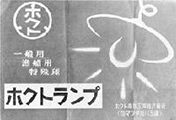
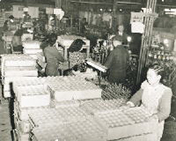
Founded on September 20, 1950 in Asahikawa as Hokuto Electric Light Bulb Industry Co., Ltd., our company began its journey towards growth, focusing primarily on general lighting bulbs.
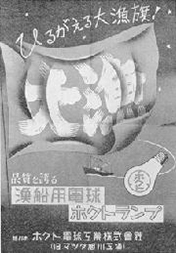
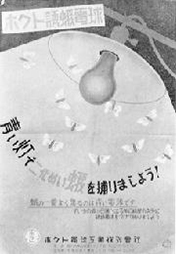
In 1952, the company began producing Hope light bulbs, special light bulbs for fishing boats, and moth trap light bulbs.
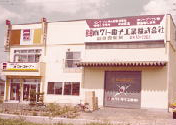
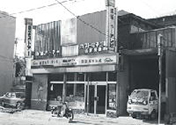
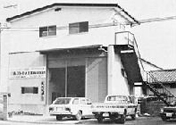
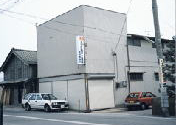
In 1953, we began producing Hokuto fish-attracting light bulbs (500W for saury) and opened liaison and branch offices in various locations, including Tokyo, Sapporo, and Kushiro.
The electronic age began with recycled cathode ray tubes
The arrival of the TV era
In Japan, experimental TV broadcasts began in May 1951, with full-scale broadcasts starting in February 1953. Color broadcasts began in September 1960. The popularity of TV also increased with the announcement that Tokyo would be hosting the 1964 Olympics.
In Hokkaido, NHK Sapporo Broadcasting Station began broadcasting in December 1956, and in Asahikawa, it became possible to watch broadcasts without a special antenna from 1958, which led to a remarkable increase in the penetration rate of TV receivers. With the advent of TV, huge crowds of people gathered in front of electronics stores, and coffee shops and restaurants put up signs saying "Now watching TV" as a highlight of their establishments, and TV steadily took root in people's lives.
In this situation, we planned a cathode ray tube recycling business and requested cooperation from Toshiba, which had been at the forefront of the industry in terms of both quality and quantity since completing Japan's first domestically produced TV receiver in 1939.
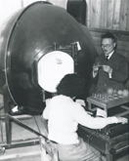
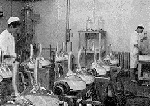
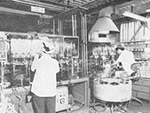
Prototype production began in January 1960. Old CRTs, the raw materials, were collected through local offices and Hokuto light bulb dealers. This type of recycling business for home TV CRTs was the first of its kind in the Hokkaido and Tohoku regions.
![[イメージ]Packaging of the cathode ray tubes named "Seven Stars" after the image of the Big Dipper](../../assets/img/company/history_img_10.jpg)
From the light bulb to the electronic era
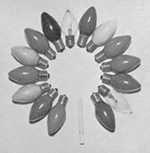
The light bulb business, which has built the foundation of our company, has shifted from producing small light bulbs for general household use to producing large light bulbs for fishing, and has worked to expand sales of fishing lights, mainly for saury and squid fishing, while also starting to produce Christmas light bulbs for the United States, Canada, and other countries. (Christmas light bulb production: 1966-1968)
The cathode ray tube business entered a period of rapid economic growth, when electric washing machines, TVs, and electric refrigerators were hailed as the "three sacred treasures." The advent of electronic calculators and the arrival of the electronic age saw the rise of computers.
On August 1, 1967, the company name was changed to Hokuto Electronics Co., Ltd. Under this new name, the company entered a period of rapid growth, with its cathode ray tube business at its core.
The rise of the lighting business and the era of display tubes
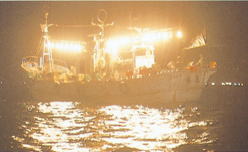
Hokuto's lights illuminate the sea
Fishing boats using fish-attracting lights began to become larger and more steel-made from the mid-1960s, and at the same time, peripheral power supply equipment such as generators and low-frequency power sources also improved significantly, leading to the widespread use of large incandescent light bulbs.
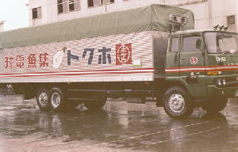
Furthermore, as ships became larger, incandescent light bulbs were replaced by halogen lamps. Our company also increased the efficiency of our saury lamps from 500W to 750W, and our squid lamps from 1KW to 2-3KW, eventually selling 5KW incandescent lamps for attracting fish. We actively expanded our sales channels using branch offices throughout the Sea of Japan, and Hokuto brand fish-attracting lights were a popular sight in seas all over the country.
![[Image]Sapporo office](../../assets/img/company/history_img_15.jpg)
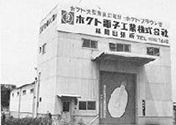
Time to spread your wings and take to the world
Increased production of large fishing lights, black and white cathode ray tubes, color electron guns, etc.
In particular, the mainstay black-and-white CRTs began to be exported in earnest to countries such as the United States and Brazil.
In the latter half of the 1970s, video games became explosively popular, and computers gradually began to appear in our everyday lives. Our company expanded its market share from consumer cathode ray tubes to industrial applications such as computer display tubes, and with an eye on expanding into the electronic circuit field, we thoroughly strengthened our structure to ensure stable management. We have continued to move forward as a unique company.
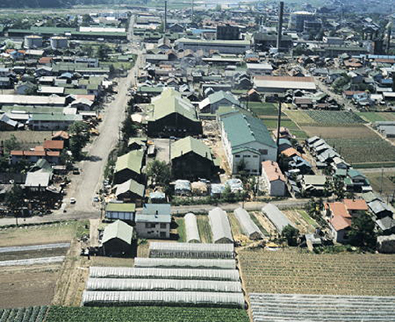
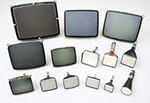
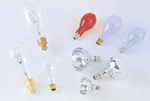
The rise of display tubes and the advent of the computer age
The lighting business, which had shown remarkable growth thanks to the growth of bulbs for large fish-attracting applications, gradually fell into a difficult situation due to the slump in the fishing industry caused by the 200-nautical-mile regulation, etc. In October 1983, the company stopped producing incandescent bulbs at its lighting factory in Asahikawa and outsourced the production of incandescent and halogen bulbs to other companies.
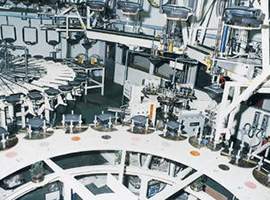
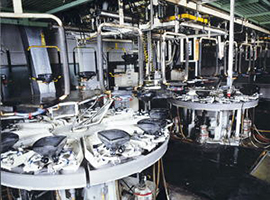
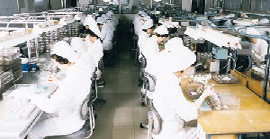
In the CRT business, demand for computer display tubes, replacing black-and-white CRTs, was increasing worldwide, and the company focused on the rapidly growing display tubes. In 1983, the company began full-scale operation of a state-of-the-art display tube production line, and the following year, in 1984, automation was introduced throughout the company to strengthen production capacity, marking the start of a leap forward for the company, with display tubes as its main product.
In 1985, we decided to produce color electron guns, and full-scale production began in April 1986.
![[イメージ]Color electron gun factory constructed (1985)](../../assets/img/company/history_img_27.jpg)
Diversified development into new businesses that lead the digital and information age
Expanding into new businesses and changing the company name
The company expanded into new businesses, starting with the flexible printed circuit board business in 1990, the manufacture of magnetrons for microwave ovens in 1991, the manufacture of surface acoustic wave devices in 1992, the manufacture of thermal printheads in 1997, the start of single crystal wafer polishing in 1998, and the start of single crystal pulling production and the launch of the projection tube business in 1999.
On April 1, 1993, the company name was changed to its current name, "Toshiba Hokuto Electronics Corporation," with the aim of selling microwave oven magnetrons under the Toshiba brand.
- (1) The "H" of Hokuto Electronics is prefixed with the "T" of Toshiba.
- (2) The long straight line extending to the right represents the company's desire for eternal growth.
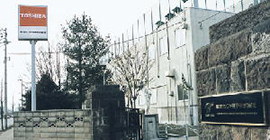
![[イメージ]1990 - Flexible printed circuit boards](../../assets/img/company/history_img_31.jpg)
Flexible printed circuit boards
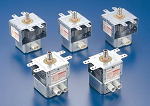
Microwave oven magnetrons
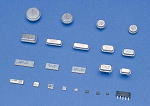
Surface acoustic wave devices
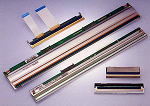
Thermal printheads
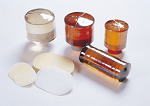
Single crystal pulling
Moving overseas and into new businesses
Celebrating the 50th anniversary of the company's founding and moving towards further development
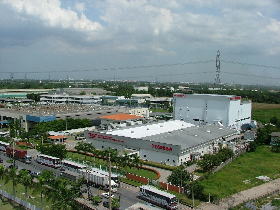
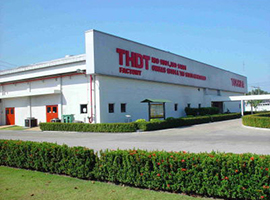
In 2000, we celebrated 50 years since we separated from Toshiba, and compiled our company history (50th anniversary history) and held a commemorative ceremony. We also outsourced the manufacture of magnetrons to Toshiba Display Devices (Thailand) Co., Ltd. (TDDT) in Thailand, and in 2003 we established Toshiba Hokuto Electronics (Thailand), which is currently our magnetron manufacturing and sales base.
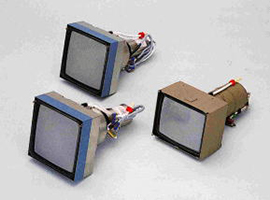
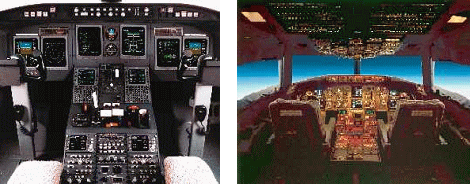
In 2002, Toshiba transferred its surface acoustic wave device business to another company, bringing an end to the production of surface acoustic wave devices that we had been manufacturing since 1992. On the other hand, since 2003, we have been working towards further development after receiving the aircraft cathode ray tube (ADT) business from Toshiba.
Developing overseas businesses and advancing into new businesses
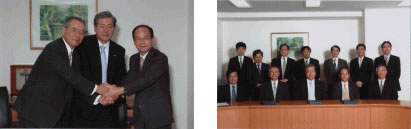
In July 2006, Daiichi Chemicals, Toshiba, and Toshiba Hokuto Electronics agreed to the joint development and commercialization of in vitro diagnostic reagents using current-detection DNA chips, and signed the "Basic Agreement on the Joint Development and Commercialization of DNA Chips."
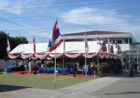
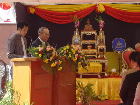
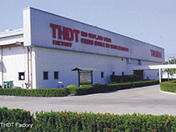
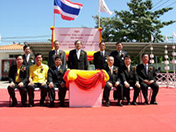
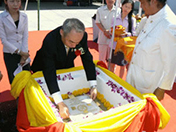
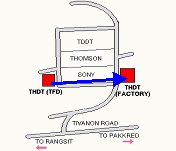
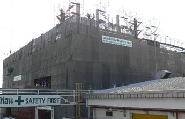
A groundbreaking ceremony for Toshiba Hokuto Electronics (Thailand) Co., Ltd.'s new building was held in September 2006. This new building is scheduled for completion in April 2007, and the plan is to consolidate the factories that were previously separated into two locations into one.
Change of company logo
In April 2007, we changed our company logo in the hopes of improving our sales power through brand image and raising awareness as a Toshiba Group company.

Completion of new building at Toshiba Hokuto Electronics Thailand Co., Ltd. (THDT)
On May 21, 2007, a ceremony was held to celebrate the completion of Toshiba Hokuto Electronics (Thailand) Co., Ltd.'s new building.